The Path to
Deep Sky
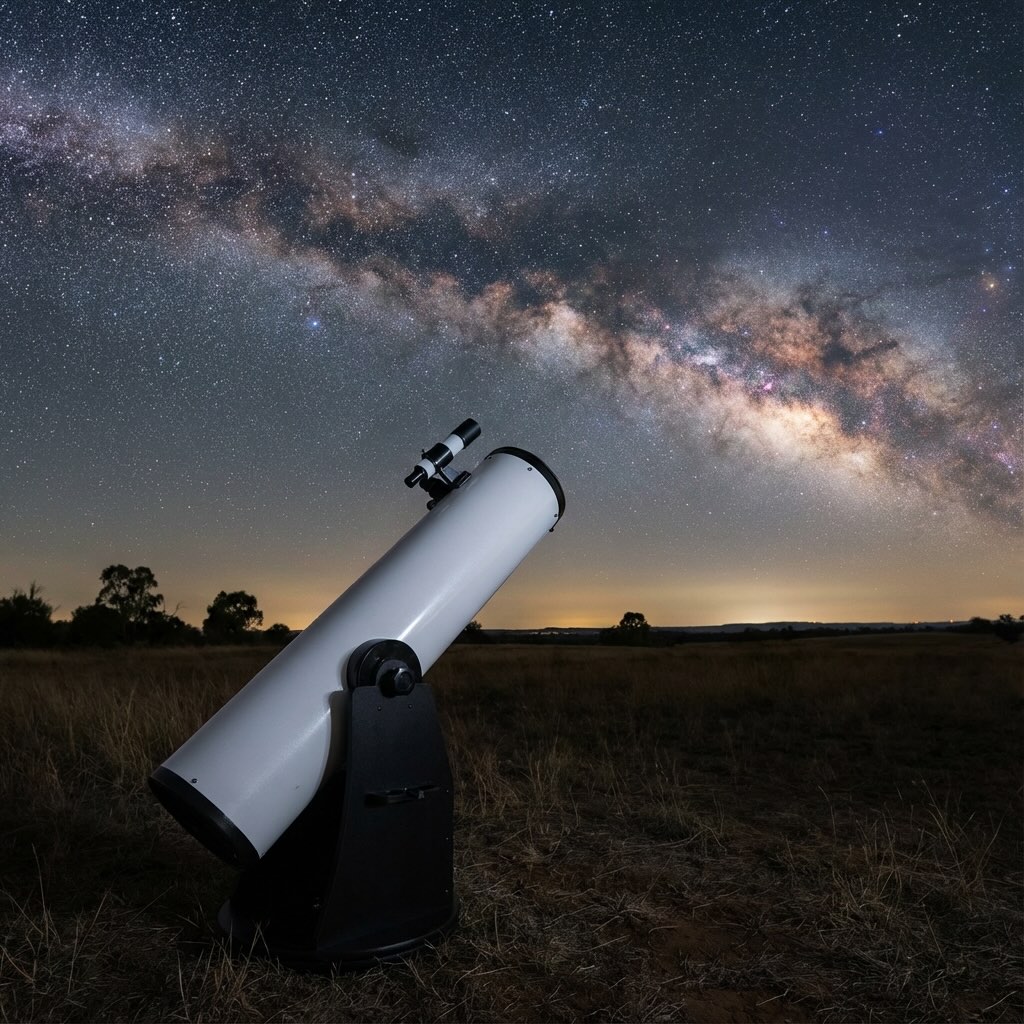
When you want to resolve the Rings of Saturn, the Bands of Jupiter, and the faint spiral arms of distant galaxies, you need Aperture—the powerhouse behind every quality beginner telescope.
Aperture is King
In astronomy, magnification is often a distraction. What really matters is Light Gathering Power. Small telescopes are "dark"; they don't capture enough photons to show contrast in faint nebulae.
For beginners, we recommend Dobsonian telescopes. These are simple "Light Buckets" that reside on a stable ground base. No complex tripods, no weight sets, just pure optical performance for your dollar. Dobsonian telescopes use a simple alt-azimuth (alt-az) mount: push up/down for altitude (vertical elevation) and swivel left/right for azimuth (horizontal direction). This setup glides smoothly under finger pressure—no motors, tripods, or counterweights needed.
With a beginner Dobsonian telescope, expect razor-sharp lunar craters, mountains, and rilles—often so bright you'll want a filter—plus vivid planetary details like Jupiter's cloud bands and four Galilean moons as pinpoint dots, Saturn's iconic rings (with the Cassini gap on steady nights), and Mars' dark patches or polar caps at opposition. Deep-sky objects like galaxies and nebulae appear as faint gray smudges rather than colorful photos, since your eyes' rod cells dominate low light and skip color; even Andromeda shows just a hazy oval core. But after 30 minutes of dark adaptation and using techniques like averted vision (glancing slightly off-target), you'll tease out subtle details. Add vibrant double stars and glittering clusters, and these real-time challenges become addictive personal triumphs that no Hubble photo can match.
Aperture Math
"An 8-inch telescope has four times the light-gathering area of a 4-inch telescope. This is the difference between seeing a faint blob and seeing individual stars in a cluster."
Grab-and-Go Power
Tabletop Models
Celestron StarSense Explorer LT 114mm/4.5 inch
The 4.5 inch Newtonian reflector with high-reflectivity coatings delivers sharp, vivid views. No experience needed! Just dock your phone, launch the StarSense Explorer app, and follow the on-screen arrows to locate stars, planets, nebulae, and more.
Celestron StarSense Explorer 130mm/5 inch
With a 20% larger light gathering ability than the StarSense Explorer LT, this 5 inch offers brighter, clearer views of faint deep-sky objects and higher potential magnification for planets.
Celestron StarSense Explorer 150mm/6 inch
With a 44% larger light gathering ability than the 5 inch, this 6 inch offers better resolution, shows fainter galaxies/nebulae, clearer planetary views, good balance of performance and size.
The Light Buckets
Full Size Dobsonians
Sky-Watcher Flextube 200 Dobsonian 8-inch Collapsible
Get a bright, bold viewing experience with this collapsible 8-inch Dobsonian telescope. Unique strut design allows for optical tube to collapse for ease of portability while keeping collimation. It's perfect for stargazers of all skill levels and is easy to transport and store.
SkyWatcher Flextube 300 SynScan Dobsonian 12-inch Collapsible
Computerized GoTo Large Aperture TelescopeUsing all-metal gearing on a pair of DC servo motors, the SynScan Dobsonian combines the precise automated tracking of a computerized GoTo telescope with the bright large-aperture viewing of a Dobsonian.
Ready for the Robot?
If you want to move beyond manual observation and start taking stunning deep-space photos automatically, explore our guide to smart telescopes and astrophotography.
View Advanced Gear* As an Amazon Associate, Nightsky Spots earns from qualifying purchases. Your support helps us maintain our scientific database of over 6,600 dark sky locations.