The Stealth
Power-Up
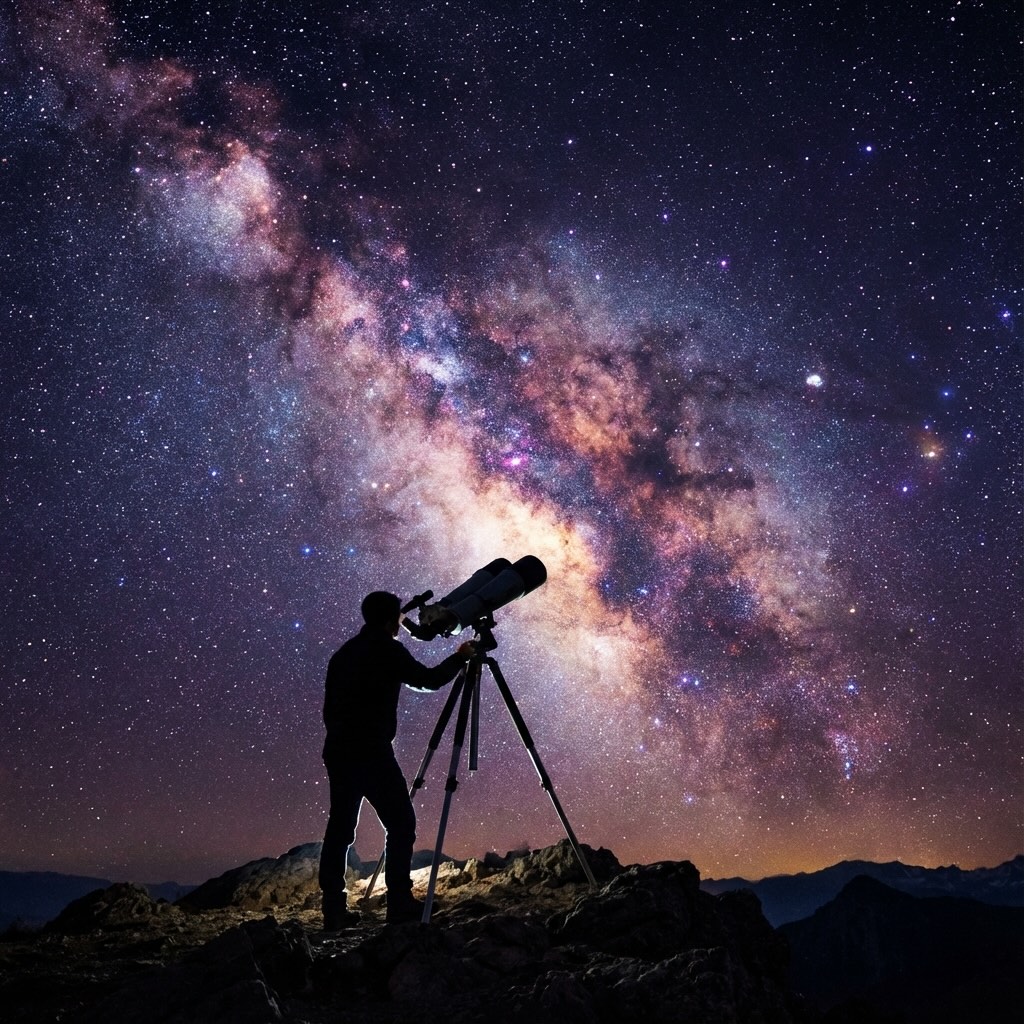
Binoculars are the "secret weapon" of the professional astronomer. While telescopes offer high magnification, binoculars offer immersion.
Why Binoculars First?
Beginners often leap straight to telescopes, only to battle heavy setups, fiddly alignments, and disorienting inverted views that make the sky feel alien rather than inviting. Binoculars eliminate these barriers completely, delivering instant, frustration-free access to the cosmos.
When you look through binoculars, you are using Binocular Vision. Your brain is optimized to process signal from two eyes simultaneously, which actually helps you resolve faint details (like the spiral arms of Andromeda) better than a single-eye telescope of similar aperture. Plus, their wide field of view sweeps star clusters and nebulae effortlessly
🔭 The 7x50 Secret
"If you see numbers like 7x50 or 10x50, here is the rule: The first number is magnification (7x bigger). The second is the size of the lens in millimeters. For stargazing, we want at least 50mm lenses to 'drink' enough starlight."
The Binocular
Target List
These are some great targets to unlock with binoculars. They are vast enough that a telescope actually "misses" them by zooming in too far.
- The Pleiades (M45) A dazzling swarm of hot blue baby stars piercing the winter dust like diamonds scattered on black velvet—perfectly framed to reveal the glowing nebula tendrils that hug the cluster.
- The Andromeda Galaxy (M31) Our nearest galactic neighbor appears as a ghostly, elongated glow spanning several full moon widths; trace its spiraling arms and ponder light that's journeyed 2.5 million years to reach your eyes.
- The Beehive Cluster (M44) Dozens of sunny golden stars buzzing in Cancer like a celestial beehive—binoculars unveil the loose, sparkling sprawl that evokes a busy summer apiary against the Milky Way backdrop.
- Orion Nebula (M42) A stellar nursery exploding in gas clouds and fledgling stars; the wide view shows its billowing 'wings' and sword-tip glow like a cosmic fireworks displays.
Gravity is
the Enemy
Binoculars are light, but after 5 minutes of looking straight up, your arms will shake. Pro-Tip: Lean your back against a car or a tree, or better yet, use a reclining lawn chair. This stabilizes your body and turns a "shaky" view into a crystalline one.
Handheld Heros
Entry Level Optics
Celestron Cometron 7x50 Binoculars
The gold standard for beginners. Massive 50mm objective lenses gulp down light, making faint star clusters pop.
Nikon ACULON A211 10x50
Ergonomic, Lightweight Body Design with higher magnification than Celestron. Uses multi-coated Eco-Glass lenses and BaK-4 prisms, delivering clear images.
Celestron–Nature DX ED 12x50 Premium Binoculars
Rugged, waterproof, and nitrogen-purged to prevent fogging. Extra-Low Dispersion glass virtually eliminates chromatic aberration or color fringing. You'll enjoy razor-sharp images with outstanding, true-to-life color.
Premium Sky Sweepers
Advanced Tier
Celestron SkyMaster 20x80 Binoculars
Giant astronomy binoculars with massive 80mm objective lenses and 20x power. BaK-4 prisms maximize light throughput to your eye so you see brighter, more detailed images.
Canon 15x50 Image Stabilized Binocular
A built-in system with a Vari-Angle Prism instantly corrects for hand tremors and vibrations, providing a stable, magnified view without a tripod, a huge advantage at 15x magnification.
Ready for Magnitude?
If you've mastered sweepings the sky with binoculars and want to see the rings of Saturn, it's time to explore entry-level telescopes.
Explore Telescope Guide* As an Amazon Associate, Nightsky Spots earns from qualifying purchases. Your support helps us maintain our scientific database of over 6,600 dark sky locations.